

To remember a bird call, create a short acoustic description in your own words, connect it to the bird and context, test yourself with the answer hidden, and revisit the sound after increasing delays. When two birds are confused, practice them together and name the difference.
Memory phrases and sound-alike words can open the door, but a phrase alone is fragile. The same syllables sound different across accents, birds vary their delivery, and many calls do not resemble speech. Strong recall combines a verbal cue with rhythm, pitch, tone, visual structure, and a real encounter.
Build a cue around the sound itself
After listening, close the reference and describe four properties:
- Pitch and direction: high, middle, low, rising, falling, or level.
- Rhythm: evenly spaced, accelerating, halting, paired, or separated into phrases.
- Tone: clear, fluted, buzzy, nasal, metallic, rough, dry, or breathy.
- Repetition: one note, a fixed phrase, alternating units, or continuous variation.
Turn the result into one compact cue: “three high clear whistles, then a faster tail.” It should tell your future self what to listen for. Emotional labels such as “sad” or “excited” may support the memory, but they are subjective and should not be the only evidence.
Use words and mnemonics as scaffolding
A mnemonic maps rhythm and emphasis onto a phrase you already know. The best mnemonic is often the one you invent because the act of generating it creates a personal association. Speak it with the recording, then remove the words and listen for the underlying contour.
Use three kinds of association when they fit:
- Rhythmic phrase: a line of words matching the number and spacing of notes.
- Sound texture: a comparison such as a squeaky wheel, bouncing ball, flute, buzz, or rattle.
- Scene memory: the exact place, weather, behavior, and people present when you first confirmed the bird.
Practice confusing birds as a pair
Studying similar birds on different days can preserve the confusion. Put them side by side. Play A, play B, and complete a contrast statement: “A is thinner and faster; B is lower with longer pauses.” Shuffle both recordings and answer until the distinction survives several examples.
Keep the pair ecologically realistic. Compare birds that overlap in range, season, and habitat, or sounds you personally mistake for each other. Contrast training should reduce a real field ambiguity rather than manufacture one.
Make a confusion card
- Names and photos of both species
- One shared feature that explains the confusion
- One reliable difference in rhythm, pitch, or tone
- Habitat, height, season, or behavior that helps separate them
- Two or more recordings of each species
Use short, spaced retrieval
Listen once to learn, then test after a gap: later the same day, the next day, several days later, and again the following week. Adjust the schedule to performance. A bird recalled quickly across different recordings can wait longer; a persistent confusion should return sooner.
Keep sessions small. Five minutes retrieving five birds can be more diagnostic than thirty minutes replaying fifty. Stop before attention collapses, and end with one bird you know well so its cue remains clean.
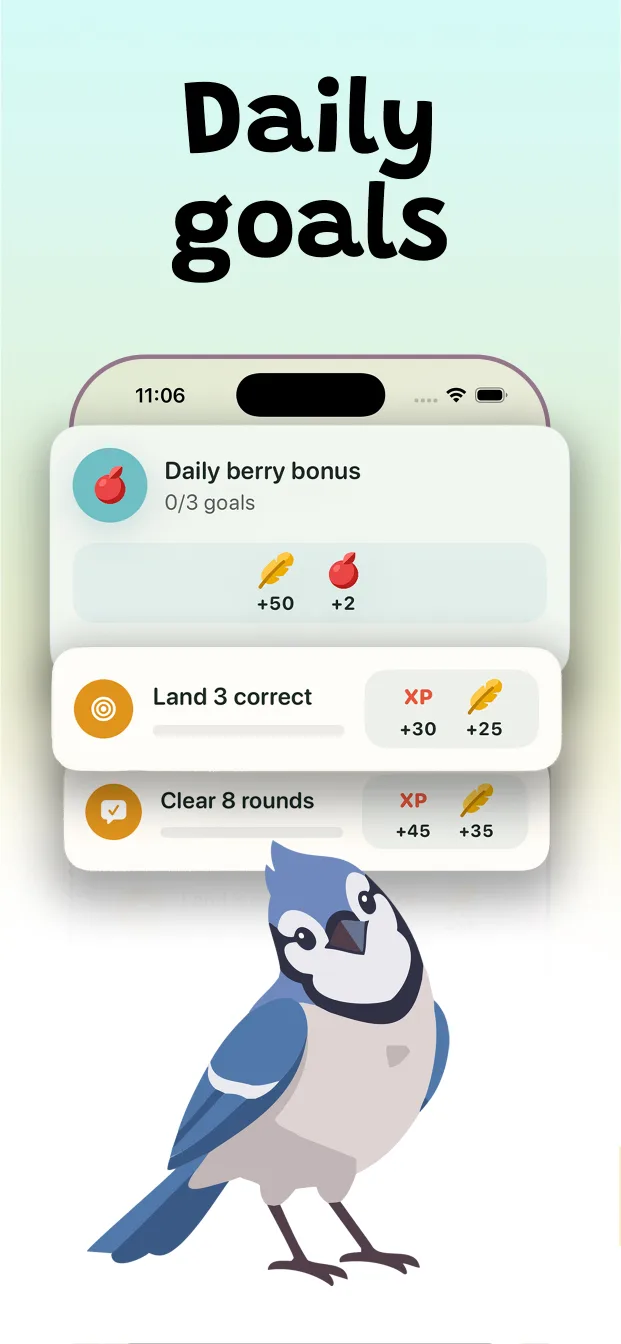
Short daily goals make review visible without requiring a long study session, which is exactly how spaced retrieval sticks.
Download Syrinx on the App Store →Make field encounters part of the memory
When you hear a target bird outdoors, pause before opening a reference. Describe the sound, predict the species, note habitat and behavior, and then verify. This retrieval attempt connects the clean study recording to the noisy situation where recognition matters.
A compact field note can include:
- date, time, place, weather, and habitat;
- sound category: song, contact call, alarm, flight call, or uncertain;
- your acoustic description and mnemonic;
- the initial identification and alternatives;
- how the identity was confirmed.
Revise your cue after each encounter. If a mnemonic works only for one recording, preserve the broader pitch, rhythm, and tone features that recur across individuals.
How Syrinx reinforces recall
Syrinx combines multiple licensed recordings with sound, photo, name, typed-answer, and spectrogram quizzes. Review returns missed or confused birds, while a regional map limits the active set. Daily goals and streaks make the useful behavior easy to repeat, but the learning still depends on attentive retrieval.
Try the free bird-song quiz, then apply the cues outdoors with the field identification checklist.