

The syrinx is the vocal organ of birds. In most birds it sits low in the airway, where the trachea divides into the two main bronchi. Air passing through vibrating soft tissues creates sound; muscles, air pressure, and the rest of the vocal tract shape that sound into a call or song.
We hear a robin's fine warble or a cardinal's clean whistle as something effortless. Under the feathers, it is a quick piece of coordination between breathing, muscles, vibrating tissue, and movement of the throat and beak. The name of this hidden instrument is also the name we chose for our bird-song learning app.
What is a bird's syrinx?
Humans make voiced sounds in the larynx, near the top of the windpipe. Birds have a larynx too, but their main sound source lies much farther down. The syrinx is usually built around the junction where one airway becomes two, close to the lungs and heart.
Modified rings of cartilage or bone support the organ. Inside are soft tissues—often called labia or, in some anatomical descriptions, tympaniform membranes—that can be brought into the flow of air. A central support called the pessulus stands at the fork between the bronchi in many birds. The details vary considerably between groups, so there is no single syrinx blueprint that fits every species.
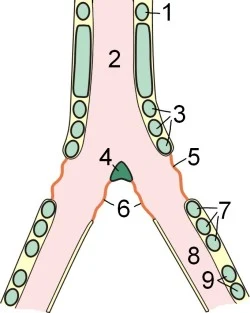

How breath becomes birdsong
During vocalization, air from the respiratory system moves through the bronchi and syrinx toward the trachea. When the sound-producing tissues are positioned in that airflow, pressure sets them oscillating. Those oscillations disturb the air and begin the sound wave.
Syringeal muscles alter the position and tension of the tissues and help regulate the passage of air. Breathing pressure matters too. The result is not a finished song yet: the trachea, throat, mouth, tongue, and beak can filter or reshape the sound on its way out. A bird's voice is therefore produced by a system, not by one membrane acting alone.
Why people say birds can have “two voices”
In many songbirds, the left and right sides of the syrinx can act as separately controlled sound sources. A bird may switch rapidly between them, use them together, or—in some vocalizations—produce two unrelated frequencies at once. That does not mean every bird always sings two notes, or that every species has the same degree of independent control.
The Northern Cardinal offers a beautiful example. During a broad rising whistle, it can produce the lower part with one side of the syrinx and continue the higher part with the other, passing between them so smoothly that we hear one continuous sweep. Other birds use the paired organ differently: the anatomy provides possibilities, but each species has its own motor patterns and repertoire.
One organ, many designs
A dove's coo, a raven's croak, a duck's quack, and a thrush's flute-like song do not come from identical instruments. The supporting skeleton, vibrating tissues, muscles, airways, and control of the two sides differ across bird lineages. Even close relatives can use similar anatomy in different ways.
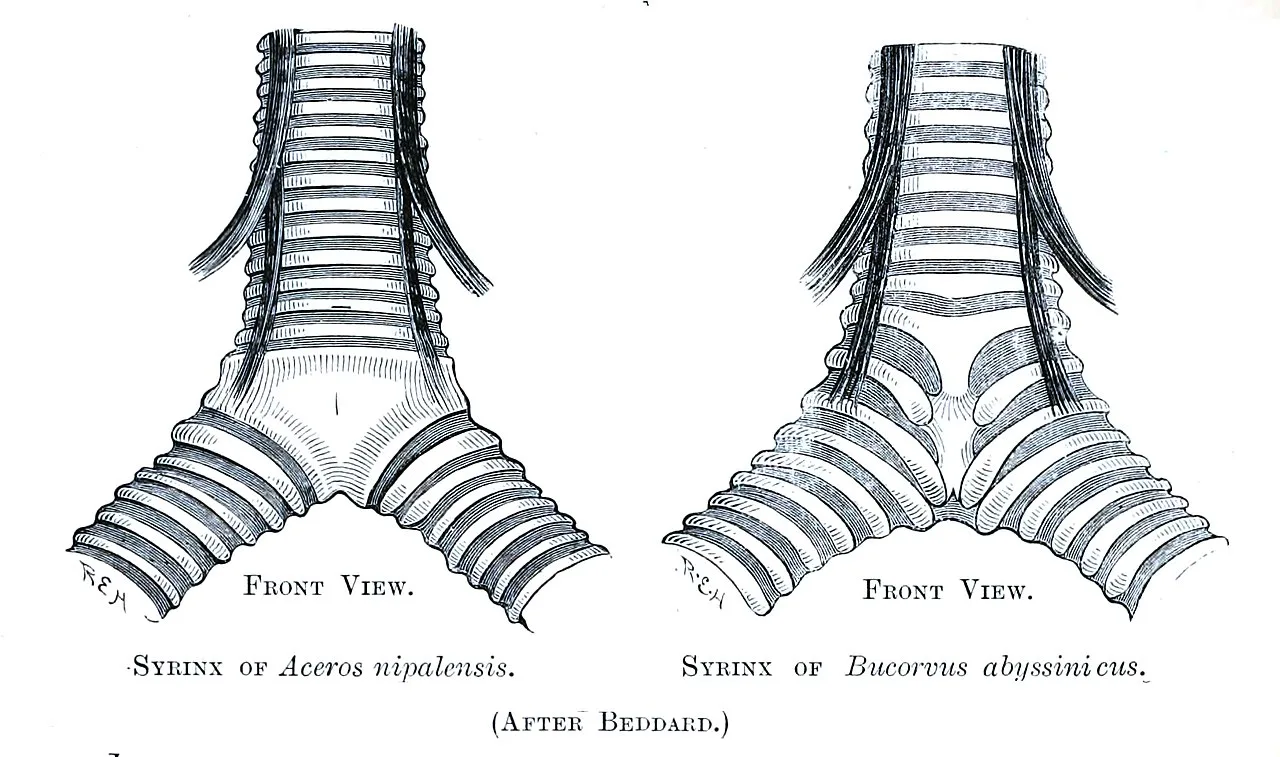

Some songbirds have several pairs of intrinsic muscles capable of fine control. Other birds have a simpler muscular arrangement and still produce voices perfectly suited to communication. Hummingbirds are an unusual case: a study of four North American species found the syrinx farther forward, in the neck, with a complex structure that evolved independently toward several songbird-like features.
The oldest described fossil syrinx comes from Vegavis, a bird that lived near the end of the Cretaceous, roughly 66–69 million years ago. Soft vocal anatomy rarely fossilizes, so that specimen tells us the organ is ancient without revealing exactly when birds first evolved it—or what those early voices sounded like.
How the syrinx gave our app its name
When we were looking for a name, we kept returning to the physical source of every sound the app asks you to learn. “Syrinx” felt precise without being clinical: a small, mostly unseen structure that gives each bird a recognizable voice.
It also captured what we wanted the app to do. Syrinx does not listen through the microphone and hand you a species name. It brings you closer to the sound itself—its rhythm, pitch, texture, repetition, and visible shape—until recognition belongs to you. The organ makes the voice; the app helps you learn it.
Does anatomy help you identify a bird?
Usually not in a direct, one-organ-one-answer way. You cannot hear a note and reconstruct every cartilage or muscle behind it. But anatomy explains why useful listening features exist. A sudden frequency jump may involve a change of sound source. Two simultaneous tones may reflect coordinated sources or nonlinear vibration. A sweep, trill, or buzz leaves a pattern that you can hear and often see in a spectrogram.
The practical lesson is simpler: describe what the bird does with sound. Listen for pitch movement, note spacing, repetitions, changes in tone, and the boundaries of a phrase. Then compare those clues with habitat, season, and behavior. Learn that process in our field identification checklist, or see vocal patterns frozen in time in the spectrogram guide.
Hear a bird, commit to an answer, and use visual and verbal clues to understand what made that voice recognizable.
Download Syrinx on the App Store →Sources and image licenses
- Cornell Lab Bird Academy: How and why birds sing
- Cornell Lab Bird Academy: The syrinx of the Northern Cardinal
- Kingsley et al.: New perspectives on the origins of the unique vocal tract of birds
- Riede and Olson: The vocal organ of hummingbirds shows convergence with songbirds
- Clarke et al.: Fossil evidence of the avian vocal organ from the Mesozoic
- Avian syrinx schematic by Uwe Gille, CC BY-SA 3.0
- Hornbill syrinx plate by F. E. Beddard, public domain